EquiView Blog
SEBI's Digital Accessibility Mandate Explained: What Every Stock Broker Needs to Know in 2026
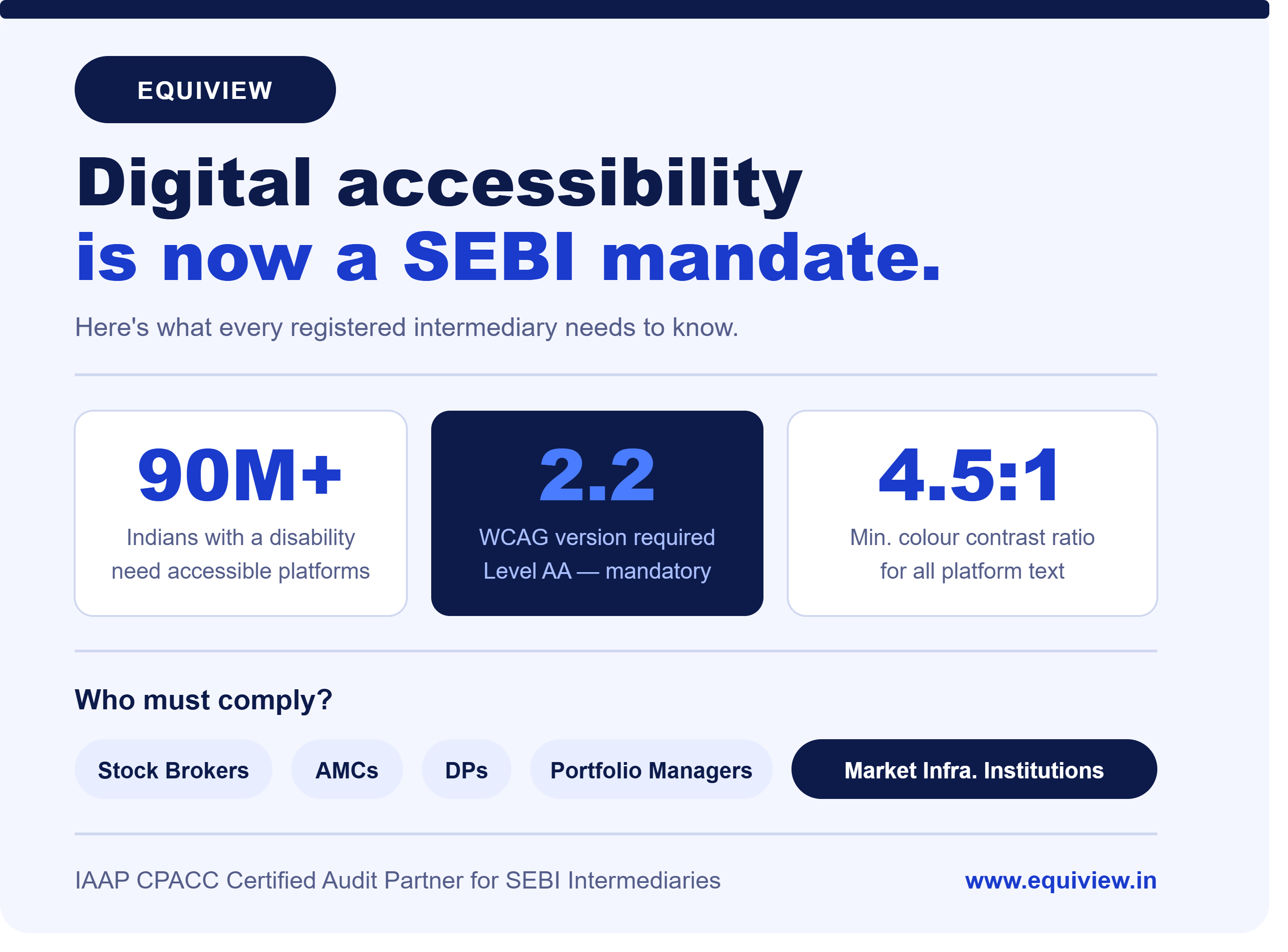
In a nutshell: SEBI has made digital accessibility mandatory for all registered financial intermediaries in India. If your stock broker website, trading app, or investor portal is not WCAG 2.2 compliant, you risk regulatory penalties and exclude millions of investors with disabilities.
What Is Digital Accessibility and Why Does It Matter for Capital Markets?
Digital accessibility means websites, mobile apps, and digital documents can be used by everyone, including people with visual, hearing, motor, or cognitive disabilities. It ensures that a visually impaired investor using a screen reader can place a trade just as easily as any other investor.
India has over 90 million people living with some form of disability, according to the Census of India. Many are active participants, or aspiring participants, in capital markets. When brokerage platforms, mutual fund portals, and investor education resources are inaccessible, they are exclusionary.
SEBI recognised this gap and issued circulars directing registered intermediaries to make digital infrastructure accessible under internationally recognised standards.
The SEBI Circulars: What Did They Actually Say?
- September 2023 Circular: SEBI directed stock exchanges, depositories, and market infrastructure institutions to comply with WCAG 2.1 Level AA guidelines.
- December 2023 / Subsequent Circulars: The scope was expanded to all SEBI-registered intermediaries, and the requirement was upgraded to WCAG 2.2 alignment.
"All SEBI registered intermediaries shall ensure that their websites and applications are compliant with Web Content Accessibility Guidelines (WCAG) 2.1 / 2.2 at Level AA." — SEBI Circular (paraphrased)
This requirement is a regulatory directive with audit and reporting obligations, not an optional best practice.
Who Does This Apply To?
| Entity Type | Examples | Digital Touchpoints Covered |
|---|---|---|
| Stock Brokers | Zerodha, Angel One, ICICI Direct | Trading platforms, websites, mobile apps |
| Depository Participants (DPs) | CDSL, NSDL DPs | Demat portals, e-DIS systems |
| Asset Management Companies (AMCs) | Mutual fund houses | Investor portals, NAV dashboards, SIP journeys |
| Portfolio Managers | PMS providers | Client reporting platforms, web dashboards |
| Market Infrastructure Institutions | NSE, BSE, CDSL, NSDL | Exchange websites, investor grievance portals |
What Is WCAG 2.2 and What Level Is Required?
WCAG, published by W3C, is the global standard for accessible web content. It is based on four principles: Perceivable, Operable, Understandable, and Robust (POUR).
| Level | Description | SEBI Requirement |
|---|---|---|
| Level A | Minimum accessibility requirements | Baseline to satisfy |
| Level AA | Globally recommended standard | Required by SEBI |
| Level AAA | Enhanced accessibility | Encouraged, not mandatory |
Key Requirements Under WCAG 2.2 Level AA
1) Text Alternatives
Charts, infographics, and stock visuals must have meaningful alternatives for screen readers. A candlestick chart without description is a compliance failure.
2) Colour Contrast
Text contrast must be at least 4.5:1 (or 3:1 for large text). Color alone should not indicate status (for example, only red/green).
3) Keyboard Navigation
All critical actions such as order placement and portfolio checks must work without a mouse.
4) Focus Visibility (New in WCAG 2.2)
Keyboard focus must be clearly visible as users move through interactive elements.
5) Accessible PDFs
SIDs, KIMs, reports, and statements must be tagged and readable. Scanned image PDFs are non-compliant.
6) Accessibility Statement
Intermediaries must publish a statement describing conformance level, known gaps, and a mechanism to report barriers.
What Are the Consequences of Non-Compliance?
SEBI can inspect intermediaries and initiate enforcement action for non-compliance. Additional risks include investor complaints on SCORES, reputational damage, potential legal exposure under the RPwD Act, and loss of market opportunity.
How to Get Compliant: A Step-by-Step Roadmap
- Accessibility Audit: Conduct a full WCAG 2.2 AA audit of web, app, and documents.
- Gap Analysis: Prioritize critical, major, and minor issues.
- Remediation: Fix accessibility barriers in code, design, and documents.
- Re-testing: Validate fixes and prevent regressions.
- Accessibility Statement: Publish status, date, and contact channel.
- Ongoing Monitoring: Re-audit at least annually.
Why the Auditor's Certification Matters
Automated tools alone catch only a subset of issues. SEBI-grade compliance requires expert manual testing by qualified professionals. IAAP CPACC is the global benchmark for accessibility competency and audit quality.
Frequently Asked Questions
Does this apply to mobile apps as well?
Yes. iOS and Android trading apps are in scope, including VoiceOver/TalkBack support and mobile interaction accessibility.
Are downloadable PDFs covered?
Yes. Investor-facing PDFs must be accessible, tagged, and readable by assistive technologies.
How long does a compliance audit take?
Typically 4 to 6 weeks for a brokerage website and mobile app, depending on complexity.
Can automated tools alone ensure compliance?
No. Automated scanners usually detect around 30-40% of issues. Manual testing is essential.
The Bottom Line
SEBI's digital accessibility mandate is now a core compliance obligation for financial intermediaries. The firms that act early can reduce regulatory risk and build a better investor experience for everyone.
Ready to begin your SEBI accessibility audit?
EquiView is an IAAP CPACC-certified accessibility audit firm focused on SEBI-registered financial intermediaries.
Visit: www.equiview.in