EquiView Blog
WCAG 2.1 vs 2.2 — What Changed and Why It Matters for Indian Brokers
In a nutshell: WCAG 2.2 is the current global accessibility standard, and SEBI's own circulars now reference "WCAG 2.1 / 2.2 at Level AA." If your brokerage platform was audited against 2.1 a couple of years ago, nine new success criteria have since been added — several of which directly affect trading flows, login screens, and mobile apps. Here's exactly what's new, what stayed the same, and what Indian stock brokers, DPs, and AMCs need to check.
Why This Comparison Matters Right Now
SEBI's accessibility circulars don't force intermediaries to pick one version and stop there. They point to "WCAG 2.1 / 2.2 Level AA" as the benchmark, and WCAG 2.2 is the version currently maintained by the W3C. That means an audit done purely against 2.1 in 2023 or 2024 is already out of date. If your platform's last accessibility review predates late 2023, there's a real chance it hasn't been checked against the newer criteria at all.
This isn't a full rewrite of the guidelines. It's an extension. But a few of the additions map almost exactly onto the pain points that show up most often in brokerage platforms: OTP-heavy logins, drag-based UI elements, and small tap targets on mobile trading apps.
The Short Version: What Actually Changed
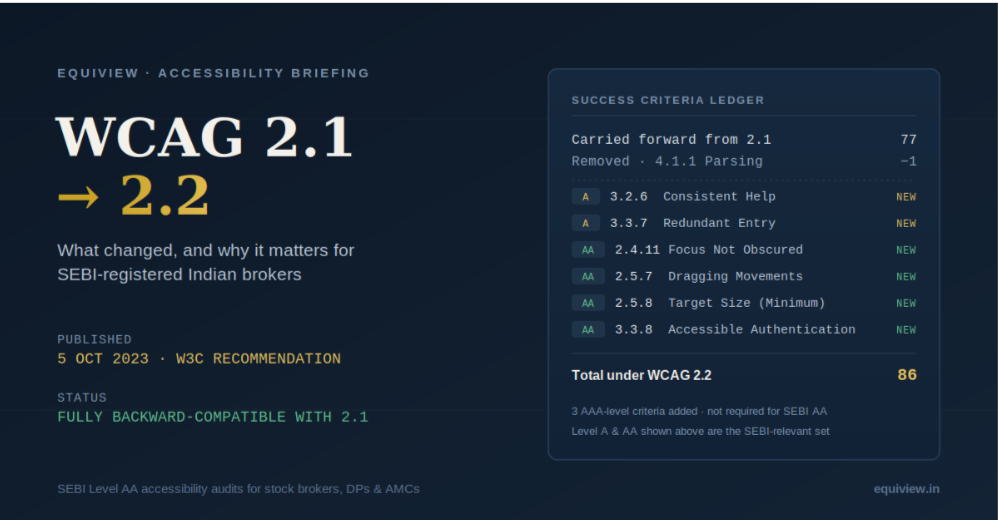
WCAG 2.2 became an official W3C standard on October 5, 2023. It builds directly on top of WCAG 2.1 rather than replacing it — every criterion from 2.1 carries forward, with one exception.
| WCAG 2.1 | WCAG 2.2 | |
|---|---|---|
| Published | June 2018 | October 2023 |
| Total success criteria | 78 | 86 |
| New criteria added | — | 9 |
| Criteria removed | — | 1 (4.1.1 Parsing) |
| Backward compatible | — | Yes, with 2.1 and 2.0 |
| SEBI reference | Yes | Yes |
If your platform already conforms to WCAG 2.1 AA, you are most of the way there. The gap to close is a defined, finite list — not a fresh audit from zero.
What Was Removed: 4.1.1 Parsing
WCAG 2.2 formally retired Success Criterion 4.1.1 Parsing, which required valid, non-duplicated HTML markup so assistive technology could parse a page correctly. Modern browsers and screen readers now handle malformed markup gracefully, so the criterion no longer adds practical value. This is a housekeeping change and doesn't require any action from brokers.
The 9 New Success Criteria in WCAG 2.2
The new criteria are spread across three conformance levels. For SEBI compliance, the Level A and Level AA criteria are what matter — six of the nine.
Level A (2 new)
3.2.6 Consistent Help Level A
If your platform offers a help option (chatbot, contact link, help center), it needs to appear in the same relative place across pages. For a trading app, this typically covers the "Need Help" or grievance contact link across order screens, KYC flows, and account pages.
3.3.7 Redundant Entry Level A
Users shouldn't have to re-enter the same information twice in one process. This is directly relevant to multi-step KYC, e-DIS, and SIP setup journeys where PAN, bank details, or OTPs are often asked for more than once.
Level AA (4 new) — the ones SEBI-registered platforms should prioritise
2.4.11 Focus Not Obscured (Minimum) Level AA
When a user tabs through a page with a keyboard, the focused element (a button, a field) must not be completely hidden behind sticky headers, cookie banners, or chat widgets. Common failure point on brokerage sites with fixed navigation bars.
2.5.7 Dragging Movements Level AA
Any interface that relies on drag-and-drop (reordering a watchlist, adjusting a slider for SIP amount or price range) must offer a single-tap or click alternative. Users with limited motor control cannot always perform a precise drag.
2.5.8 Target Size (Minimum) Level AA
Interactive elements like buttons and icons must be at least 24×24 CSS pixels, or have enough spacing around them. Mobile trading apps with small buy/sell icons are a frequent failure point here.
3.3.8 Accessible Authentication (Minimum) Level AA
Login and OTP flows cannot rely purely on cognitive tests (like transcribing a code from memory) without an accessible alternative, such as copy-paste support for OTPs or biometric/password manager compatibility. Given how much of Indian fintech login flow is OTP-based, this is arguably the single most relevant new criterion for brokers.
Level AAA (3 new — encouraged, not mandatory)
2.4.12 Focus Not Obscured (Enhanced), 2.4.13 Focus Appearance, and 3.3.9 Accessible Authentication (Enhanced) raise the bar further but are not required for SEBI's Level AA mandate. Firms aiming for a more future-proof platform can treat these as a roadmap item rather than an immediate compliance task.
Quick Reference: New Criteria at a Glance
| Criterion | Level | What It Affects on a Trading Platform |
|---|---|---|
| 3.2.6 Consistent Help | A | Help/contact link placement |
| 3.3.7 Redundant Entry | A | KYC, e-DIS, SIP setup forms |
| 2.4.11 Focus Not Obscured | AA | Sticky headers, chat widgets, cookie banners |
| 2.5.7 Dragging Movements | AA | Watchlist reordering, sliders |
| 2.5.8 Target Size | AA | Buy/sell buttons, mobile icons |
| 3.3.8 Accessible Authentication | AA | OTP and login flows |
What This Means for Your Next Audit
If your brokerage, DP, AMC, or PMS platform was last audited specifically against WCAG 2.1:
- You don't need to start over. Everything that passed under 2.1 AA still holds under 2.2 AA.
- Six new checks need to be added — the two Level A and four Level AA criteria above — to close the gap.
- Authentication and target size deserve the most attention. These two criteria consistently surface the most issues in fintech interfaces, since OTP-only logins and dense mobile UI are common patterns in Indian trading apps.
- Update your accessibility statement. SEBI requires intermediaries to publish a conformance statement — this should specify WCAG 2.2 as the version referenced once your platform has been re-tested.
Frequently Asked Questions
Does SEBI require WCAG 2.2 specifically, or is 2.1 still acceptable?
SEBI's circulars reference "WCAG 2.1 / 2.2 at Level AA." Since WCAG 2.2 is fully backward-compatible with 2.1 and is the current W3C standard, auditing against 2.2 is the safer and more future-proof choice for intermediaries.
If our platform passed a WCAG 2.1 AA audit, do we need a full re-audit?
No. A full re-audit is not necessary. What's needed is a targeted review against the six new Level A and AA criteria, plus a re-test of anything that changed on the platform since the last audit.
Which new criterion causes the most issues for Indian brokers?
In our audits, 3.3.8 Accessible Authentication and 2.5.8 Target Size are the most common failure points, largely because of OTP-dependent logins and compact mobile UI layouts.
Is WCAG 2.2 relevant for mobile trading apps, or just websites?
Both. WCAG 2.2's new criteria — particularly Target Size and Dragging Movements — were added specifically in response to feedback about mobile and touch-based interfaces, making them highly relevant to iOS and Android trading apps.
The Bottom Line
WCAG 2.2 doesn't reset the compliance clock — it extends it. For SEBI-registered intermediaries, the practical task is narrow and well-defined: verify your platform against six new Level A/AA criteria, with particular attention to authentication flows and touch target sizes, and update your public accessibility statement to reflect the current standard.
Not sure which version your last audit covered?
EquiView is an IAAP CPACC-certified accessibility audit firm focused on SEBI-registered financial intermediaries. We can tell you exactly where your platform stands against WCAG 2.2 AA.
Visit: www.equiview.in